Canadian SaaS companies are rejuvenating Ottawa’s tech scene [Byline]

The nation’s capital is tech sector is experiencing a renaissance due in part to Canadian SaaS companies.

Nearly two decades ago, Ottawa was poised to become a technology powerhouse, fuelled by a strong telecom sector that included Newbridge Networks and its numerous spinoffs, Corel CEO Michael Cowpland’s belief he could take on Microsoft by buying WordPerfect, and a general feeling the city could be more than a sleepy government town as the Feds were shedding jobs to balance the books. The concept of Canadian SaaS companies was yet to be born.

By the new millennium the dot com bubble had burst, Nortel was in disarray and once promising Newbridge spinoff CrossKeys were shutting its doors. While the city’s tech sector has continued to grow steadily, it’s only been recently that Ottawa has caught a second wind. And like many other cities, it’s been due in part to startups. Local stars include Shopify, a wildly successful e-commerce platform, and Halogen Software, a provider of cloud-based talent management software.

However, enterprise software is also fueling the tech renaissance in the nation’s capital, and Ottawa has become a hub for Software-as-a-Service (SaaS) startups. The worldwide market for public cloud services was forecast to reach $204 billion by the end of last year putting the nation’s capital front and center of Canadian SaaS companies. More broadly, Canadian SaaS startups are garnering worldwide attention and investment. For example, Salesforce acquired SaaS startups Golnstant from Halifax, Rypple from Toronto, and Radian6 from Fredericton, for a total of half a billion dollars in 2014.

The boom of Canadian SaaS companies in Ottawa demonstrates a recognition by the city of where its strengths lay. For example, Accelerator L-SPARK was formed two years ago to specifically tap into the city’s enterprise software potential, and the city is a welcoming place for startup Canadian SaaS companies and legacy enterprises because past successes have laid the foundation. The legacies of Mitel, Nortel, Newbridge Networks and Cognos groomed experienced executives who are now mentoring new entrepreneurial talent through accelerators and community groups such as Invest Ottawa, Startup Garage and Wesley Clover.

The city has already given the Silicon Valley North moniker two decades ago, but in comparison to its California counterpart, Ottawa has lower housing and salary costs and lots of room for businesses to grow. The nation’s capital is also in the top three rankings of Canadian cities for its quality of life, environmental sustainability, and for its suitability for families — giving it broad appeal to entrepreneurs and employees alike.  The nation’s capital alone is home to more than 580 software companies employing 22,000 people. In fact, boasts the highest concentration of talented scientists and engineers in the country.

One challenge that has dogged the Canadian tech sector for decades is attracting the same level of venture capital as U.S. startups. One of the drivers behind L-SPARK was to help Ottawa SaaS enterprise software startups, as well as Canadian SaaS companies, attract investment in Canada rather than having to travel to Silicon Valley to participate in competitive American seed accelerators such as Y-Combinator.

There are signs that more VC money is finding its way to Canada, however. Last year was a bright spot for tech investment in the country, according to the MoneyTree Report from PwC Canada and CB Insights. It bucked a global trend of a 10 per cent decline in VC deals in 2016 and a 23 per cent drop in total funding compared to 2015. Ottawa struck 10 deals in 2016, averaging US$13 million each.

Another indicator of Canada’s healthy SaaS situation was last year’s augural Annual SAAS NORTH Conference, which is returning to Ottawa for a second year in November. The event is expected bring more than 1200 attendees, 400 companies, and 70 speakers together, and will include new features such as roundtables, AMAs (Ask Me Anything), as well as an updated Investor Zone. According to event organizers, the trade show portion is expected to double in size.

Gary Hilson is a freelance writer with a focus on B2B technology, including information technology, cybersecurity, and semiconductors. A revised version of this article was published on Tektonika Canada.

Micron Talks 3D NAND Sans Intel [Byline]

TORONTO — On the heels of shaking up its partnership with Intel, Micron Technology Chief Technology Officer Ernie Maddock took the stage at the J.P. Morgan 16th Annual Tech Forum at the 2018 International CES to field questions about the road ahead.

In a Q&A and session moderated by Harlan Sur, analyst for U.S. Semiconductor and Semiconductor Capital Equipment Research at J.P. Morgan, Maddock emphasized that the update to Micron’s working relationship with Intel is only related to NAND development.

At the top of the week, the companies announced they have mutually agreed to work independently on future generations of 3D NAND. Micron and Intel will complete development of their third-gen 3D NAND technology toward the end of the year and into 2019. Maddock said based on evolving roadmaps and the needs of each company’s respective markets, it made sense to diverge for the next node.

Read the full article over at EE Times.

Gary Hilson is a freelance writer with a focus on B2B technology, including information technology, cybersecurity, and semiconductors.

NVM Express Set for Busy 2018 [Portfolio]

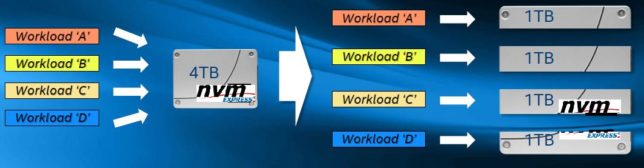
TORONTO — Following on the heels of a major specification update and its eighth annual plug fest, NVM Express is poised to have a busy year as it continues to develop the base NVMe specification while expanding the NVMe Management Interface (NVMe-MI) specification and one for accessing SSDs on a PCIe bus over fabrics.

In June, the NVMe specification got its first major update in nearly three years, putting it on the cusp of becoming the defacto standard for SSD interfaces. Version 1.3 added a significant number of new features, something that hasn’t been done since November 2014, encompassing 24 technical proposals spread across three major buckets that address client, enterprise and cloud features. Most significant was improved support for virtualization so developers can more flexibly assign SSD resources to specific virtual machines, thereby addressing latency.

Meanwhile, the eighth NVMe Plugfest at the University of New Hampshire Interoperability Laboratory last fall offered the first official NVMe Over Fabrics (NVMe-oF) compliance and interoperability transport layer testing for RoCE, Remote Direct Memory Access (RDMA) over Converged Ethernet, and the Fibre Channel. UNH-IOL fills the role of independent testing provider of standards conformance solutions and multi-vendor interoperability, and the latest plugfest generated 14 new certified products for the base NVMe integrators list and one for the NVMe-MI integrators list. Eight inaugural products were also approved for the newly launched NVMe-oF integrators list, which accepts RoCE initiators and targets, Ethernet switches, as well as Fibre Channel initiator, targets and switches and software.

Read the full story over at EE Times.

Go green with clean tech business solutions [Portfolio]

You’re probably all getting pretty tired of the debate raging on about the role of oil pipelines in our economy, but hopefully some info on clean tech has cut through all the noise. Behind the scenes, Canadian clean tech has been soldiering on, leveraging information technology, the Internet of Things (IoT), and even quantum computing to promote sustainability as modern tech drives us forward.

And with Canada’s Environment Minister as one of 30 committed to the Paris Accord, there are plenty of greenfield opportunities to build business solutions around clean tech in Canada. Better yet: There’s an important role for skilled IT people to play.

Read the full story over at HP Tektonika.

IBM Simulates Complex Chemistry with Quantum Computing [Byline]

TORONTO — A novel algorithm developed by IBM scientists is improving the understanding of complex chemical reactions and optimizing quantum computing.

The scientists have developed a new approach to simulate molecules on a quantum computer using a seven-qubit quantum processor to address the molecular structure problem for beryllium hydride (BeH2), which is the largest molecule simulated on a quantum computer to date, according to IBM. The results are significant as they could lead to practical applications such as the creation of novel materials, development of personalized drugs and discovery of more efficient and sustainable energy sources.

In a telephone interview with EE Times, IBM quantum computer research team member Abhinav Kandala outlined how they implemented an algorithm that is efficient with respect to the number of quantum operations required for the simulation. Using six qubits of a seven-qubit processor, they were able to measure BeH2’s lowest energy state, a key measurement for understanding chemical reactions. The results were just published in the peer-reviewed journal Nature, which Kandala co-authored.

Read the full story on EE Times.

Gary Hilson is a freelance writer with a focus on B2B technology, including information technology, cybersecurity, and semiconductors.

MRAM Momentum Poised to Disrupt Memory Workhorses [Byline]

TORONTO — Last year could be described as a tipping point for the magneto-resistive random access memory (MRAM) market. Up until then, Everspin Technologies was the only company shipping commercial MRAM products. But as Spin Transfer Technologies (STT) CEO Barry Hoberman is always quick to acknowledge, Everspin’s success has helped to pave the way for other MRAM players.

The genesis of STT goes back as far as 2001 with technology originally developed from research conducted by New York University Professor Andrew Kent. STT was formed and incubated by Boston-based Allied Minds in 2007. In September 2016, the developer of orthogonal spin transfer MRAM technology (OST-MRAM) announced it had fabricated perpendicular MRAM magnetic tunnel junctions (MTJs) as small as 20nm at its development fab based at the company’s headquarters in Fremont, Calif.

Since then, STT has delivered samples of its spin transfer torque MRAM to customers in North America and Asia, a milestone that’s significant in that it’s one of several emerging memories considered to be a next-generation candidate to replace DRAM and NAND flash, which face scaling challenges as the industry moves to smaller nodes. STT is one of a handful of firms developing MRAM, so the delivery of samples is an important proof point validating both MRAM in general, and STT’s technology in particular.

EE Times recently spoke with Hoberman about the company’s ramp up, and the opportunities for MRAM as more players go to market, including where it might be a viable replacement for incumbent technologies.

Read the full Q&A on EE Times.

Gary Hilson is a freelance writer with a focus on B2B technology, including information technology, cybersecurity, and semiconductors.

Avoidable IoT security vulnerabilities are unacceptable—period [Portfolio]

It seems like just yesterday everyone was gearing up to secure their organization for the anticipated BYOD deluge. Today, IoT security has quickly evolved to become the new front line in our connected world.

In early February, a grey-hat hacker compromised as many as 150,000 printers using an automated script that searches for open printer ports to send out rogue print jobs. He was able to affect printers of all makes and sizes at both large enterprises and small town restaurants. This hacker claimed he didn’t intend to cause harm, according to reports. Instead, he was educating people to the dangers of exposed devices and holes in IoT security. The reality is that the consequences of a single, exposed device can be far worse depending on what networks it’s connected to.

Read my full story on Tektonika.

Faster Networks Push Interface Development [Byline]

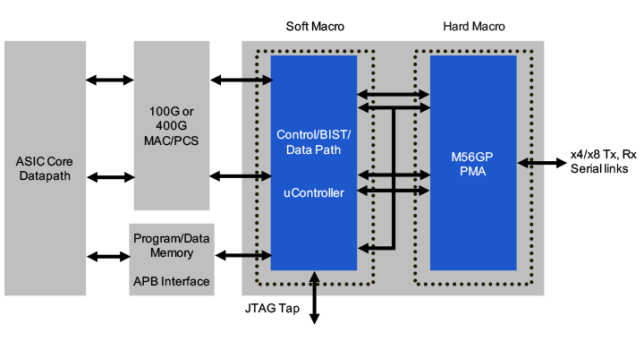
TORONTO – As Ethernet speeds get faster, Rambus is looking to make sure memory and interfaces can keep up with the recent launch 56G SerDes PHY.

The analog-to-digital converter (ADC) and (DSP) architecture of the 56G SerDes PHY is designed meet the long-reach backplane requirements for the industry transition to 400 GB Ethernet applications, said Mohit Gupta, senior director of product marketing at Rambus. This means it can support scaling to speeds as fast as 112G, which are required in the networking and enterprise segments, such as enterprise server racks that are moving from 100G to 400G.

“Ethernet is moving faster than ever,” Gupta said. “The pace has picked up substantially due to big data, the Internet of Things (IoT) and other trends putting high demands on communication channels. There is already a forum for 112G SerDes speed which will drive the 800G standard.”

One clear usage case, said Gupta, is data center deployment by the “big four” — Facebook, Microsoft, Amazon and Google.

Read my full article on EE Times.

Gary Hilson is a freelance writer with a focus on B2B technology, including information technology, cybersecurity, and semiconductors.

For Barcodes, The Best May Be Yet To Come [Portfolio]

Barcodes are ubiquitous around the world. They’ve been a mainstay of grocery stores for decades, and in the past ten years, found on mobile phones and advertising. But the history of barcode technology goes back much further, and the use cases for it continue to evolve.

Read more on the Accusoft blog.

Gary Hilson is a freelance writer with a focus on B2B technology, including information technology, cybersecurity, and semiconductors.

Wireless Disruptor Distinguishes Itself with Supply Chain Innovation [Portfolio]

The consumer wireless market in in the United States is extremely competitive, but when you’re looking to disrupt business models and also provide e-commerce in crowded market, competition is even fiercer.

For Republic Wireless in Raleigh, North Carolina, product innovation and customer service is how it looks to differentiate itself. It’s one of as  many as 50 mobile virtual network operators (MVNOs) competing for customers along with the four big wireless carriers. Since launching its services in 2010, supply chain efficiency has been a key component of the company’s success and growth. Read my full article on EBN Online.