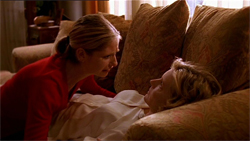
 It’s been several weeks since “The Body” aired, and I’m still trying to digest the viewing experience. Suffice it to say, if this brilliant hour of television doesn’t earn Buffy The Vampire Slayer an Emmy nod, I don’t know what will.
I was prepared to get weepy a week before “The Body” actually aired, since Joss Whedon and company have this habit of pulling out the rug in the last five minutes of an episode just to keep you thinking about the series for the coming week, but I wasn’t prepared for how poignant the episode would be on so many fronts. First off, there’s Sarah Michelle Gellar’s performance. While she’s had plenty of opportunities before to show her acting chops and act grief stricken, the situation Buffy faces in this episode leaves her particularly vulnerable and powerless to act. It’s something new for the character and is the foundation of “The Body.” For the first time, Buffy doesn’t have a demon or monster she can fight. The enemy here is much more mundane.
The supporting cast does just as much to make this episode emotionally powerful. The tears were welling up quite a bit as Willow (Alyson Hannigan) frets over what wear to the hospital. There’s a very touching moment as Tara (Amber Benson) comforts Willow with a long tender kiss. Kudos to Whedon and co. for writing that scene into an episode that was about something much bigger and more important, rather than making a big deal about with an an episode specifically based on the couple’s first on-screen kiss.
But the real scene stealer came from an unexpected source: Anya (Emma Caulfield). A character that normally has grated on me for the last year or so managed to basically deliver the most heart wrenching lines in the entire episode.
“The Body” deals with death in a very raw, realistic manner, capturing the awkwardness people feel as they try to figure out what they should do or say when faced with the loss of a loved one. Whedon’s direction deserves much of the credit for the episode’s realism and the decision to forgo a musical score was definitely the right one.
Buffy The Vampire Slayer has been skirted the edges of conventional critical acclaim for a while now. “The Body” is absolute proof that a television show doesn’t have to be about cops or doctors to be a legitimate drama. When watching it for the second and even the third time, it still reaches right into my soul, which is something I don’t say lightly. The third season episode “Amends” is right up there, but I’m inclined to go further back to Homicide: Life on the Street’s “Crosetti” for comparison, and that’s high praise.
Unfortunately, I’m far too jaded to believe that the Emmys would ever recognize a genre show such as Buffy, even if it is long overdue.
Gary Hilson is a writer, editor and digital media specialist for hire. He lives in Toronto.